
Maximilian James
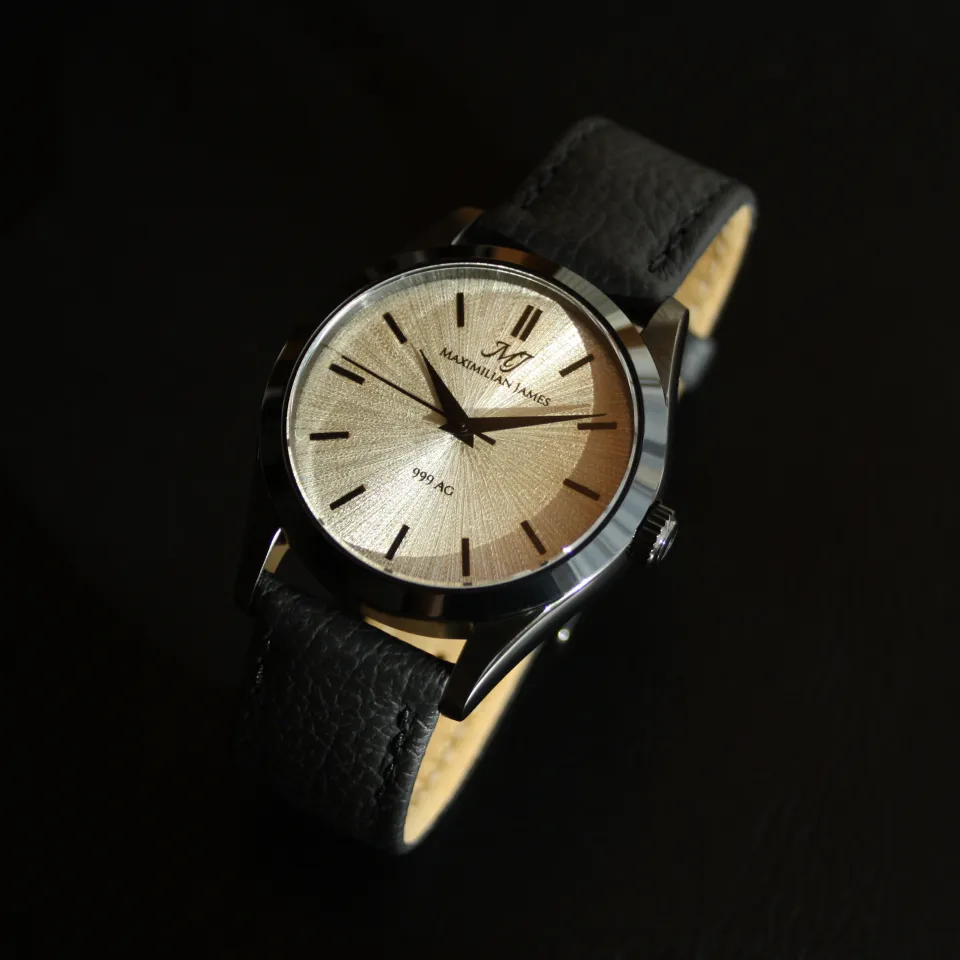
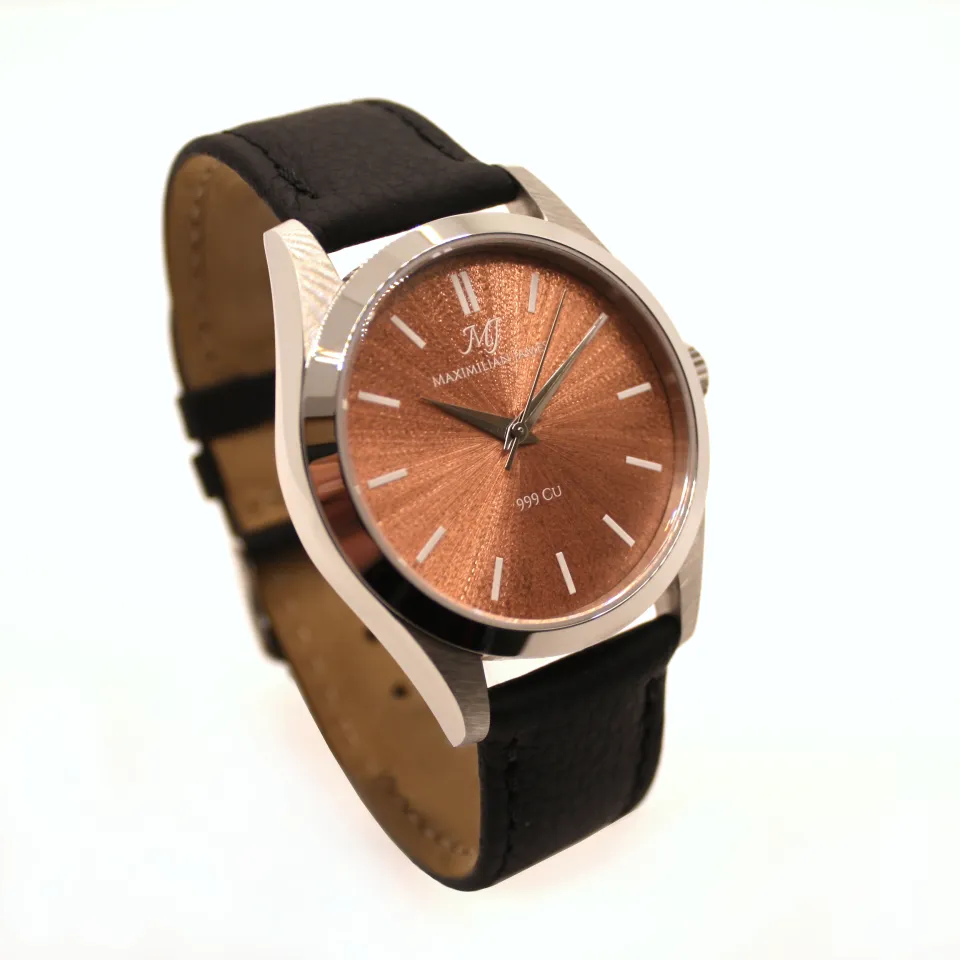
Maximilian James builds wristwatches with dials cut from a single, unalloyed element — osmium, ruthenium, tantalum, gold, silver or copper. MetaMetals produces and certifies the dial. He grinds every one of them by hand.
We make the dial. He makes it beautiful.
Four stages, and a clean division of labour. MetaMetals produces the solid osmium dial, certifies it, and sends it to Bavaria. Maximilian James grinds it before it is assembled to its final state.
Sintering the block
Osmium cannot be melted and cast. The powder is sintered — pressed under extreme pressure at high temperature in an oxygen-free environment — into a dense, pore-free solid block.
Slicing and certifying
Dial blanks of roughly 0.7 mm are wire-cut from the block. Each one gets a serial number and a digitally signed PDF certificate of authenticity before it leaves us.
The sunburst grind
He applies the sunburst finish to every dial personally, guiding the tool by hand. Two commercial finishers turned the job down before he took it on himself.
Case and movement
The finished dial goes into a 39 mm steel case with a Swiss Sellita SW300. Final assembly and inspection are carried out by white-label specialists in Pforzheim.
Maximilian James names MetaMetals as the source of his dial metals on his own website — you can verify the relationship from his side at mj-watches.com. Each watch ships with two certificates: his for the watch and ours for the dial.
Visit MJ WatchesA brand built on a refusal to dilute
Maximilian James is not an invented brand name, no — it's the founder's real name. The man behind it is Maximilian James George and his father's origin is from Great Britain (Wales), while his mother is German. His name as well as his brand name embody that.
The watches grew out of something he developed naturally — a fascination with precious metals that goes back to his early twenties. Gold and silver first, then the harder question of why nobody in watchmaking ever shows you either of them in a pure state. That argument is set out in full on the watches page; what follows here is why he took it personally enough to spend six years on it.
His framing is cosmological, and he means it fairly literally: precious metals as elements were mainly forged in neutron star mergers and now occur with a high degree of scarcity in the earth's crust. Mining such a highly scarce element and then adjusting it in an alloy for hardness or colour, on that view, is not refining it — it is veiling it. The dial is an attempt to show the elements as they were created, in their purest form possible.
"The dials showcase the elements in their natural state. They merge the colouration of the element with the sunburst polish, and turning that into a watch gives it more purpose."
Maximilian James, in conversation with MetaMetals, August 2026For Maximilian, osmium, as one of the scarcest precious metals, is also one of the most beautiful elements. But his approach was never limited to one metal. It's about the principle, applied to as many pure elements as would survive being cut to seven tenths of a millimetre and could embody his requirements for beauty, purity and scarcity.
An earlier generation of his osmium watches used crystallised osmium — the sparkling, faceted form. He moved to solid metal deliberately: crystals are rather an additional ornament to a dial than the dial metal itself; he was after understated metal rather than glitter.
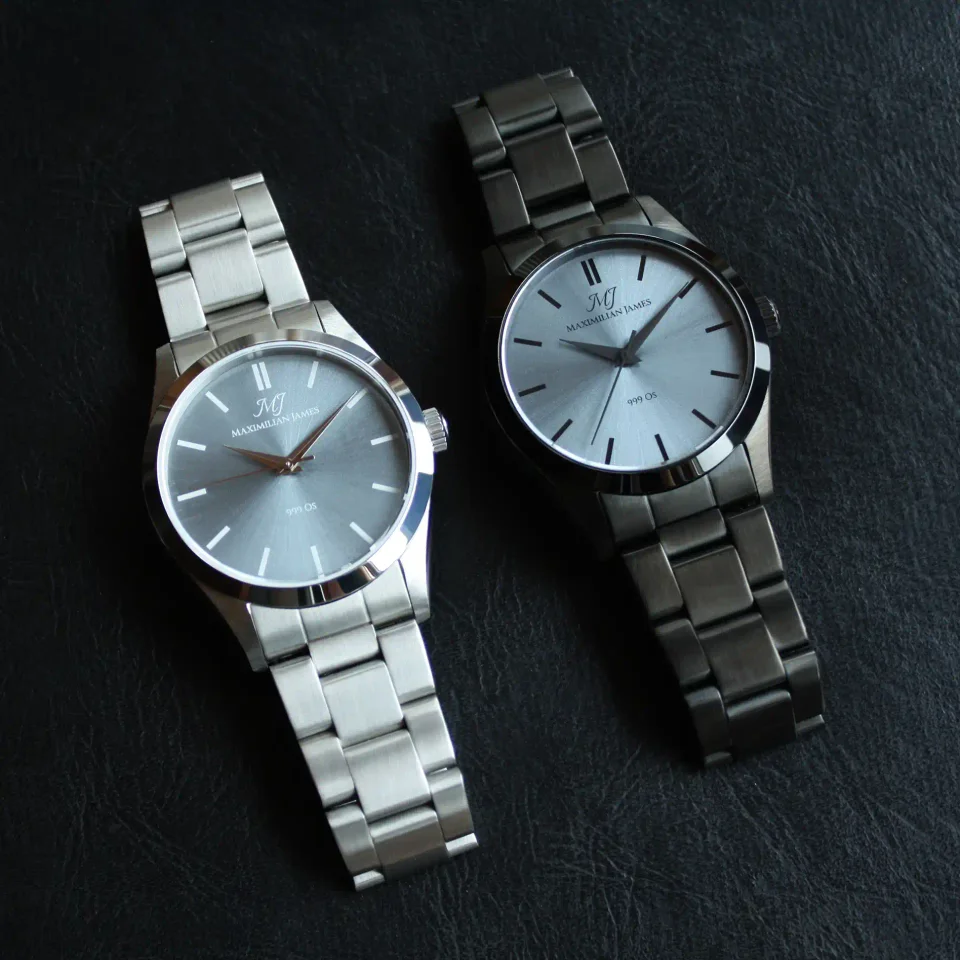
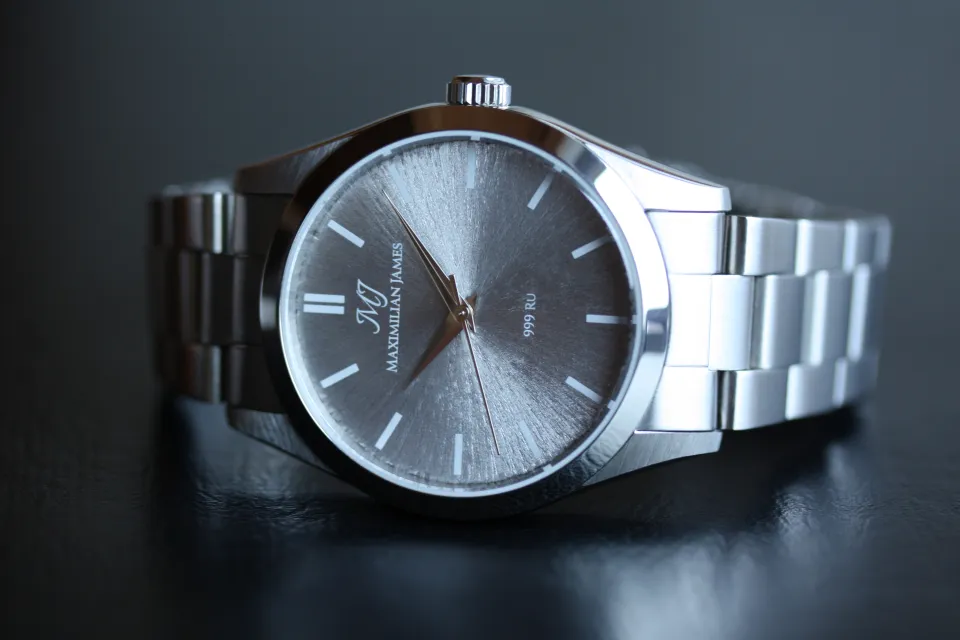
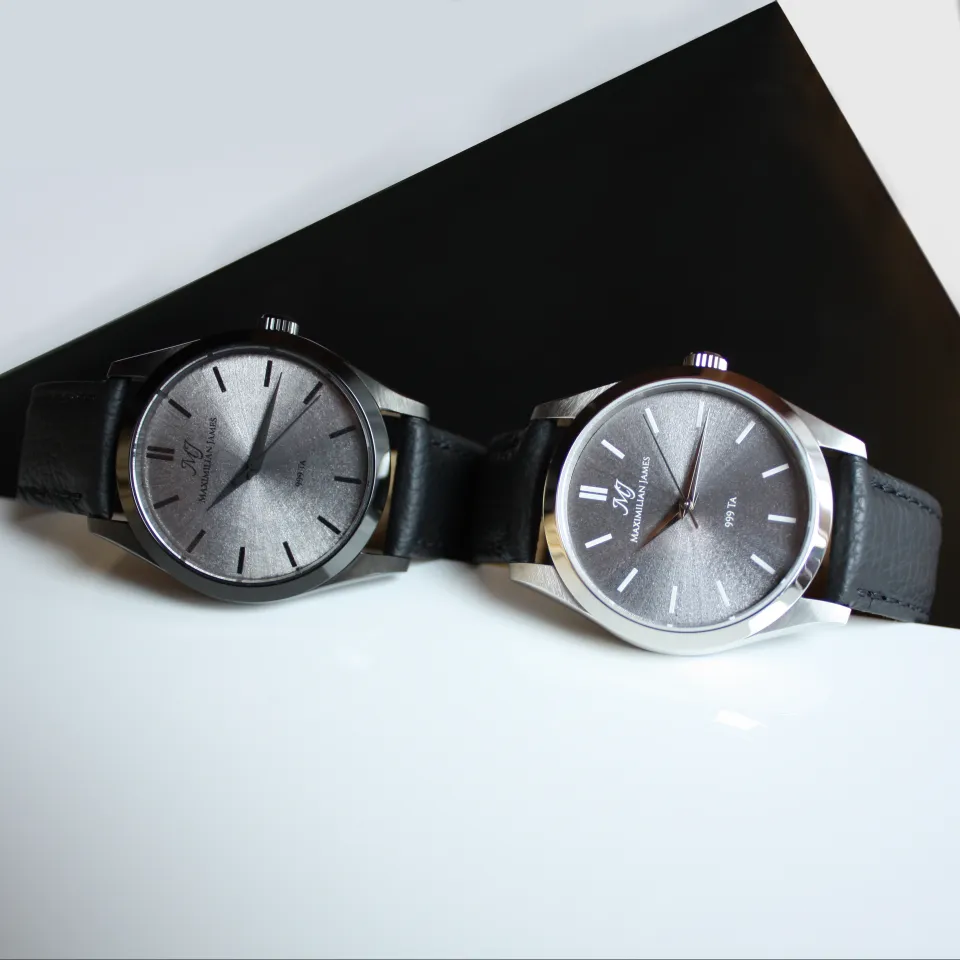
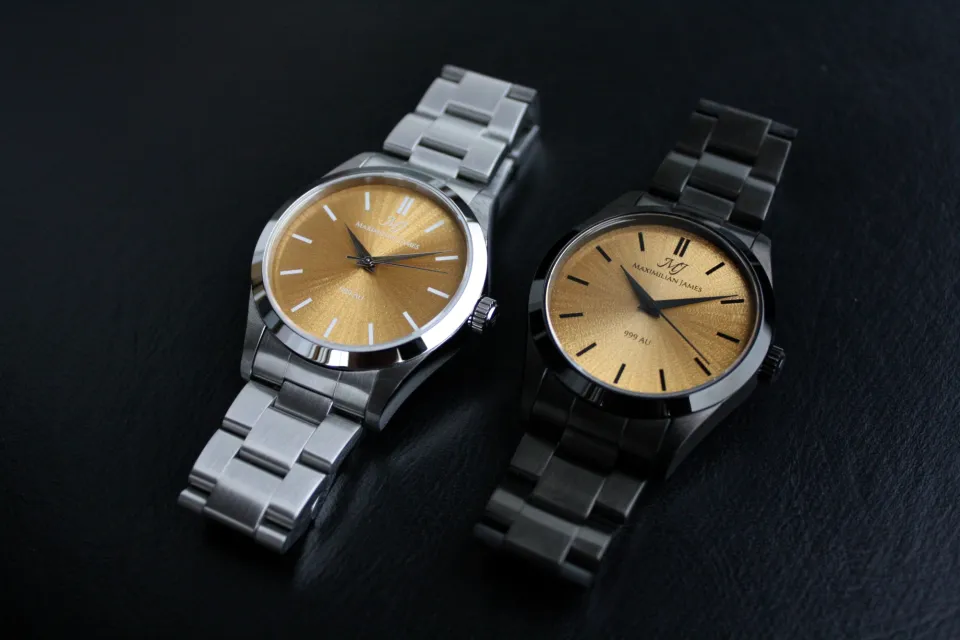
Six years, six fractures, one dial
The world's first solid, hand-polished osmium watch dial did not arrive in one step. It arrived after a series of development steps that nearly did not work, spread over six to seven years.
An inherited watch
Max inherits an old Helvetia watch from his English great-grandfather. The dial has yellowed, and replacing it conventionally strikes him as dull — so he has the watch restored and fits two tiny crystallised osmium chips to the dial himself. Small crystals were the only osmium he could afford at the time.
A budget quartz model
To put osmium on more wrists without a luxury price, he works with a partner workshop on a quartz watch using osmium crystals. It sells in low double-digit numbers — enough to prove there is interest, not enough to be the idea.
Crystals are the wrong answer
Crystallised osmium sparkles, which suits as ornament, but not as base of a dress watch's dial. What he wants is solid metal, understated. At that point osmium exists commercially only as crystals or as small melted beads — nothing you could cut a dial from.
Sintering solves it
He approaches MetaMetals in Austria. Two years pass between the first enquiry and a working prototype: sintering osmium powder into a solid block, then slicing flat discs from it. That process is now how MetaMetals osmium and ruthenium dials are made.
What almost stopped it
Osmium resists nearly every step of watchmaking. These are the specific reasons the project came close to being abandoned — worth knowing, because they are also the reasons almost nobody else does this.
It cannot be melted
Osmium's melting point is above 3,000 °C, so it cannot be cast easily into bars the way gold or silver can. It arrives as a loose powder extracted from platinum ore, which is not a shape you can make a dial out of.
Osmium powder oxidises
As a powder at room temperature, and as a solid above roughly 400 °C, osmium reacts with oxygen to form osmium tetroxide in an amount that is problematic. Heating or grinding it in open air is a genuine safety problem, not a theoretical one — which is why the sintering happens in an oxygen-free environment.
Hard and brittle at once
Osmium is extraordinarily hard, which is usually a virtue. It is also brittle: under pressure it does not deform, it shatters. Those two properties together rule out most of the standard toolkit.
Pressing straight to shape failed
The obvious shortcut — pressing osmium powder directly into a thin disc — was tried and abandoned. The discs had no structural stability. Sintering a solid block first and slicing it afterwards was the only route that held.
Nobody would polish it
One commercial dial finisher tried standard abrasives for the sunburst finish and could not make a single mark on the surface. A second said it would attempt the job only if €20,000 was paid up front to build an airtight, oxygen-free chamber — with no guarantee of success.
The dial is the expensive part
A 0.7 mm solid osmium dial weighs at least 11 g, and world output is only around one tonne a year. Most of the watch's value sits in the dial — which is why the case is capped at 39 mm. A 42 mm version would cost disproportionately more for no design benefit.
Four dial blanks fractured outright during the grinding trials and two more during the assembly. By his own account, that was the moment he came closest to abandoning the project altogether — the critics who said osmium simply could not be worked into a dial were starting to look right. What followed instead was the first commercially produced watch in the world with a solid, hand-polished osmium dial.
"The customer probably won't see all the effort that went into the osmium dial. Six dials broke in the process of making them. It was highly expensive, and there was a lot of adrenaline and nervousness involved, while polishing them. You have to apply just the right amount of pressure to get a nice shimmer, but you don't want to break the dial."
Maximilian James, in conversation with MetaMetals, August 2026The dial metals
Six elements, each unalloyed, each supplied by MetaMetals and certified at a guaranteed minimum purity of 99.95%. Almost any element can be requested for a bespoke dial.
Rarest by annual output
Osmium
World production runs to around one tonne a year against more than three thousand for gold. It is the only element with a natural blue-grey lustre in solid form — no tinting, no coating — and the densest that occurs in nature. You notice the weight before anything else.
Learn about osmium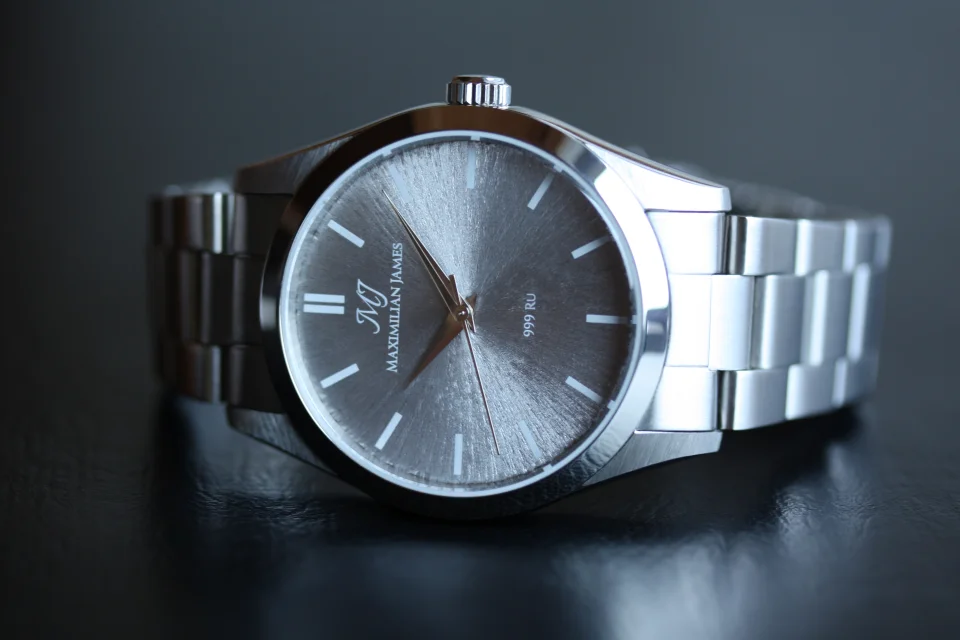
In conversation
On what he wears, what he grinds, and the dial he lost.
Recorded interview with Maximilian James on 15 August 2026, conducted by Rainer Stellnberger for MetaMetals.
"I wear a watch with a silver dial, which I use to test everything — the rigidity, the build quality, the movement. I wear it constantly, even sleeping and showering with it, so it already has a few scratches. That is normal.
For special occasions I have an osmium watch, which I try to keep in better condition because it is also worth more. But I love the silver one. It has a Milanese strap and the standard case. It is bright, silvery all over, and very elegant."
"So far, ruthenium. It is really rare, almost as rare as osmium, but it is not as brittle, so grinding it is more relaxing — you do not have the anxiety that it might break. I have only finished one ruthenium dial successfully so far, but I would like to make more."
"Apart from the broken osmium dials, there was one ruthenium dial that failed. It had too many pores from the sintering process, and I could not grind them out, so the dial was lost. That was a pity. I was never happy with it — the pores were simply too large."
Verify for yourself
- Maximilian James (registered brand name)MG Osmium UG (company name)
Represented by Maximilian James George
Johannisstraße 4, 82418 Murnau am Staffelsee, Germany
USt-IdNr. DE330915004 - Phone+49 8841 6970039 · +49 174 375 2057
- ShowroomBy appointment — worth it if you want to feel the weight
- Websitemj-watches.com — where he names MetaMetals as his dial metal supplier
- Instagram@maximilian_james_watches
- Independent interviewA conversation on a watch channel covering the Maximilian James dials in detail
Maximilian James watches: elemental dials, made in Bavaria
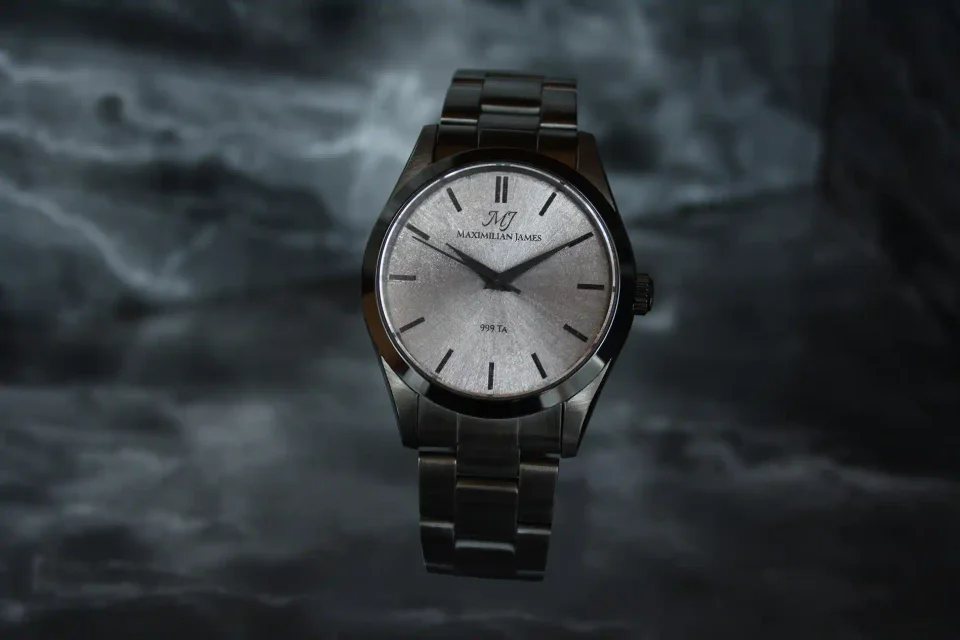
Maximilian James — often shortened to MJ Watches — is a German watch brand based in Murnau am Staffelsee, Bavaria. Its defining characteristic is the dial: a slice of a single unalloyed element rather than a printed or plated brass base. The osmium, ruthenium and tantalum dials are produced and certified by MetaMetals and hand-finished by Maximilian James; unalloyed gold, silver and copper dials are also available. Because the sunburst finish is ground by hand rather than machined, no two dials come out quite the same. After grinding, each dial receives a thin clear varnish. It leaves the colour and lustre of the metal unchanged, protects the silver and copper dials from oxidation, and carries the printed markings; it dissolves in spirit, so the element beneath is never permanently covered.
Each watch pairs the dial with a 39 mm stainless steel case just 8.65 mm thick, sapphire crystal and a Swiss Sellita SW300 automatic movement, with final assembly and inspection carried out in Germany. The dial itself is marked twice: the MJ Watches logo, the element abbreviation and the purity mark of 999 in fine print on the face, and the MetaMetals logo with the disc number stamped into the back. The watch number is engraved on the rotor, and normally matches the disc number. Every piece ships with two certificates of authenticity — one from MJ Watches for the watch, one from MetaMetals for the dial, which certifies a guaranteed minimum purity of 99.95%.
Why MetaMetals works with Maximilian James
We supply the metal and Maximilian James makes the watch, but that describes the arrangement rather than the reason for it. The reason is simpler, and it is older than the first dial.
"When Maximilian got in touch with us, it did not take long to see how much we have in common. He is a down-to-earth guy, and he has the same passion for precious metals that we do at MetaMetals: the fascination with the elements themselves, the science behind them, and the question of what it actually takes to process and refine them.
His approach is to show them in a dial as purely as they can be shown, in their most authentic state. That is the same interest, in a different form, and it motivated all of us to push this project forward."
Rainer Stellnberger, BSc CTO, MetaMetals
There is one more thing we share, and it is the approach to offer products with as much inherent value as we can. A watch can be mostly a name: take the name away and much of what you paid for goes with it. A Maximilian James watch with a MetaMetals-supplied dial is built the other way round. Beneath the brand, the movement, and the effort, there is an element that is genuinely scarce and does not stop being what it is.
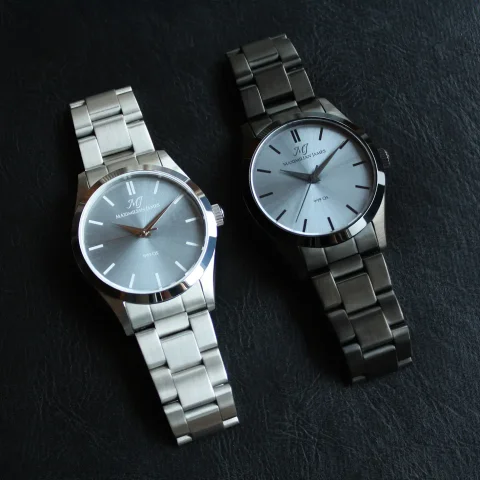
Osmium Dial Watch
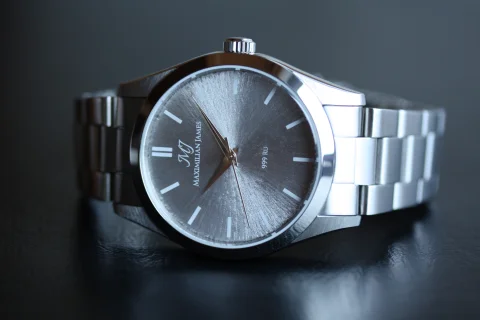
Ruthenium Dial Watch
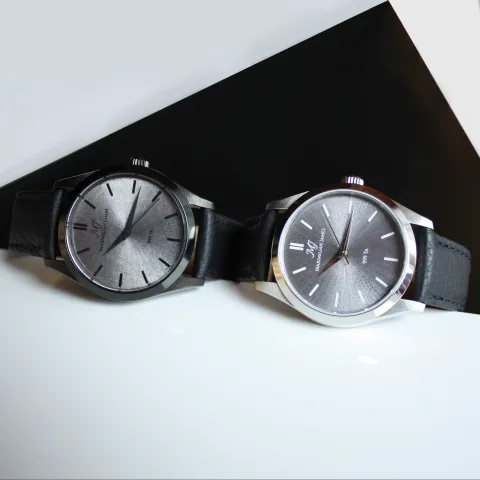
Tantalum Dial Watch
The Black Limited edition is capped at 76 pieces worldwide — osmium is element 76, and the edition size was set to match. See the full range on the watches page, or browse his gold, silver and copper models on mj-watches.com.
Other people we work with