What Is Rhodium (Rh)?
Rhodium is one of the rarest precious metals on Earth — a hard, silvery-white member of the platinum group, with the chemical symbol Rh and atomic number 45. It is best known for two things: its role as a catalyst in the automotive industry, and its extreme scarcity, which makes it one of the most valuable metals by weight.
This page explains what rhodium is, how it behaves, what it is used for, and why it is so rare. For the current market price, see our live rhodium price page; to buy certified bars, see rhodium bars.
Physical properties & discovery
Rhodium belongs to the platinum group metals, alongside platinum, palladium, osmium, iridium and ruthenium, and sits in group 9 of the periodic table. It was discovered in 1803 by the English chemist William Hyde Wollaston, who named it after the Greek rhodon ("rose"), after the rose-red colour of its salts.
As a metal, rhodium is hard, durable and highly resistant to corrosion and oxidation — it does not tarnish in air at room temperature. It has a higher melting point than gold or silver and is classed as a noble metal. In nature it occurs almost entirely as a by-product of platinum and nickel mining, overwhelmingly from South Africa.
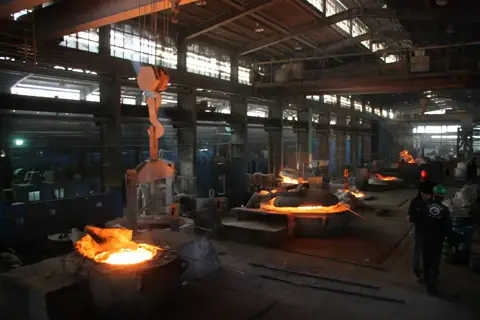
| Property | Value |
|---|---|
| Symbol | Rh |
| Atomic number | 45 |
| Atomic mass | 102.91 u |
| Group / period | Group 9, period 5 (platinum group, d-block) |
| Density | ~12.4 g/cm³ |
| Melting point | ~1,964 °C (3,567 °F) |
| Boiling point | ~3,695 °C |
| Hardness | ~6 on the Mohs scale |
| Crystal structure | Face-centred cubic |
| Colour | Silvery-white |
| Discovered | 1803, by William Hyde Wollaston |
Colour, reflectivity & rhodium plating
Rhodium's most recognisable physical trait is its bright, silvery-white colour and its very high reflectivity. It holds a brilliant, mirror-like finish and resists tarnishing, which is exactly why it is widely used to plate other jewelry — a process called rhodium plating, or rhodinating. White-gold rings, for example, are often finished with a thin rhodium layer to give them their bright white shine and added scratch resistance.
Among the platinum-group metals, rhodium is prized for having a higher lustre and reflectivity than platinum, which is part of why it is chosen as a finishing metal rather than a structural one in jewelry.
Rhodium vs. platinum: material properties compared
Rhodium and platinum both belong to the platinum group and share a silvery-white appearance and strong corrosion resistance, but they differ in key physical ways. Rhodium is harder and more scratch-resistant, has a higher melting point, and is more reflective with a brighter white finish — which is why platinum and white-gold jewelry is often rhodium-plated rather than the other way around.
Platinum, by contrast, is denser, more malleable and far more abundant, which makes it the practical choice for solid jewelry settings and bars, while rhodium is used mainly as a finish or hardening alloy. Both are noble, hypoallergenic metals suitable for skin contact.
| Property | Rhodium | Platinum |
|---|---|---|
| Density | ~12.4 g/cm³ | ~21.45 g/cm³ |
| Melting point | ~1,964 °C | ~1,768 °C |
| Mohs hardness | ~6 | ~4–4.5 |
| Reflectivity | Very high (brighter) | High |
| Malleability | Low | Very high |
| Tarnish resistance | Does not tarnish | Does not tarnish |
| Typical jewelry role | Surface finish / plating | Structural metal / setting |
| Hypoallergenic | Yes | Yes |
Is rhodium toxic or safe?
Rhodium metal itself is considered non-toxic and biologically inert — it is stable, does not corrode, and is used in jewelry worn directly against the skin. The safety considerations relate not to the solid metal but to certain rhodium compounds, some of which are classed as toxic or irritant, and to rhodium powder, which is finely divided and can be flammable.
For that reason, rhodium in a solid, processed form — such as a sintered, pressed bar — is the safe and practical form for handling and storage. Raw rhodium powder is cheaper but poorly suited to private owners: it is difficult to store safely and far less practical than a solid bar.
What is rhodium used for?
The large majority of rhodium — roughly 80% of annual demand — is used by the automotive industry in catalytic converters, where it helps convert harmful nitrogen oxides in exhaust gases into less harmful substances. There is no easy substitute for rhodium in this role, which is a major reason its price reacts so strongly to changes in car production and emissions regulation.
Beyond catalysts, rhodium is used in the chemical and glass industries, in electrical contacts and mirrors that need a durable reflective surface, and in jewelry — both as a plating metal and, in alloys, to harden and brighten platinum and palladium.
How rare is rhodium?
Rhodium is one of the scarcest elements in the Earth's crust. Only around 30 tonnes are produced per year, compared with nearly 3,000 tonnes of gold — roughly a hundredfold difference in annual supply. It is not mined on its own but recovered as a by-product of platinum and nickel mining, with the overwhelming majority coming from South Africa.
This combination of tiny supply, concentrated production and strong industrial demand is what makes rhodium so valuable and, at times, more expensive than gold by weight. The same scarcity also makes the market small and prone to sharp price swings.

A note on data sources
Crustal abundance
Published estimates for rhodium's abundance in the Earth's crust vary considerably between sources, because all platinum-group elements occur at parts-per-billion (ppb) levels where measurement is difficult and local concentrations can differ by orders of magnitude. Consensus geochemical figures place rhodium at roughly 0.7 ppb by weight, while estimates focused on the upper continental crust run lower, at around 0.018 to 0.5 ppb. Against gold's commonly cited crustal abundance of ~1.5 ppb, this makes rhodium roughly 2 to 4 times scarcer than gold on the consensus figure, widening to up to ~8× scarcer if the lower upper-crust estimates are used — though one estimate, working from a much lower rhodium value of about 0.018 ppb, would imply rhodium is dozens of times scarcer (on the order of ~80×), an outlier worth noting but not directly comparable to the consensus range. We state this as a range rather than a single multiplier, because the figure genuinely depends on which dataset is used.
Annual production
Rhodium is recovered almost entirely as a by-product of platinum and nickel refining, with global annual production of only around 30 tonnes — a fraction of gold's ~3,000+ tonnes per year. This production gap is far larger than the geological scarcity ratio alone, because rhodium has no primary ore of its own and supply is tied to other metals' mining output.
Why we hedge
Where you see "much rarer than gold" on this page, the claim is defensible by any measure — rhodium is unambiguously rarer than gold in both crustal abundance and annual production. We deliberately avoid a single precise multiplier (e.g. "N× rarer") in customer-facing copy, since a well-informed reader can find a source giving a different number. The figures above are drawn from independent scientific and government sources, not from commercially interested industry bodies.
- WebElements — Rhodium: geological information (crustal abundance in ppb by weight). https://www.webelements.com/rhodium/geology.html
- WebElements — Gold: geological information (crustal abundance ~1.5 ppb by weight). https://www.webelements.com/gold/geology.html
- Johnson Matthey — PGM Market Report: annual rhodium supply, demand and recycling. https://matthey.com/pgm-market-report
- U.S. Geological Survey — Mineral Commodity Summaries: Platinum-Group Metals (annual production figures). https://www.usgs.gov/
- World Platinum Investment Council — Platinum Quarterly (PGM demand and by-product supply). https://platinuminvestment.com/
Find answers to the most frequent questions here.